Cattle Tracking Initiative
Strategic Technology Partnership Review

Gosuncn
layout: image-right image: /hereford_two_tier_network.png
The Core Vision
Infrastructure-Free Two-Tier Network
- Goal: Eliminate dependency on fixed towers or cellular networks in vast grazing areas.
- Member Nodes (Ear-Tags): Deployed to 97% of the herd.
- Leader Nodes (Collars): Deployed to 3% of the herd for Edge Processing.
- Local Cow Network: Sub-GHz communication (Star or Mesh topology TBD).
- Modular Add-on Connectivity: NB-IoT (terrestrial fallback) + NTN Satellite (Skylo preferred) to the Cloud.
layout: section
Technical Requirements & Expected Behaviors
The Ear-Tag (Member Node)
### Hardware Constraints
| Feature | Target / Constraint |
|---------|---------------------|
| **Weight** | < 20g (Single-pin). If > 20g, dual-pin required. |
| **Power** | 3-5 years (battery/solar) |
| **Durability** | IP68+ for extreme outdoor |
| **RF Protocol** | Sub-GHz LoRa |
| **Form Factor** | Single-pin (preferred) or Dual-pin (if > 20g) |
| **Compliance** | URSEC (Uruguay RF) & SNIG (Animal Traceability) |
| **Legacy RFID** | FDX-B / HDX (134.2 kHz) backward compatibility |
### Behavior & Data Collection
| Function | Expected Behavior |
|----------|-------------------|
| **Positioning** | None (relies on Collar GNSS + RSSI) |
| **Sensors** | Accelerometer (behaviour analysis), Battery Health. *(Temp. optional)* |
| **Telemetry** | 15-minute "heartbeat" |
| **Alerts** | Immediate event-based triggers |
| **Firmware** | Burn-once (no FOTA for Phase 1) |
The Collar Tracker (Leader Node)
### Hardware Sizing Rationale
| Component | Requirement & Rationale |
|-----------|-------------------------|
| **MCU** | **Cortex-M4/M33 (e.g., nRF52/53, STM32).** Runs local Edge AI to filter telemetry and avoid expensive NTN satellite transmissions. |
| **RAM** | **Min 512KB.** Required to run Zephyr RTOS, local Sub-GHz network stack, and TinyML state-inference models concurrently. |
| **Storage** | **8-16MB Non-Volatile Memory.** Caches up to 3 days of herd telemetry (500 nodes) during satellite outages; stages dual-bank FOTA updates. |
| **Zero-Port I/O**| **Magnetic wake + NFC/BLE.** Zero physical ports. Magnetic reed switch triggers activation; BLE/NFC enables mobile onboarding and local diagnostics. |
| **Power** | **6m (Pilot) / 1yr (Production).** Achieved via aggressive GNSS duty cycling and local Sub-GHz wake-on-RF listening. |
### Behavior & Network Flow
| Function | Expected Behavior |
|----------|-------------------|
| **Node Capacity** | **500 Member Nodes.** Listens and aggregates Sub-GHz telemetry from up to 500 active ear-tags over a 1km range. |
| **Positioning** | **4+ GNSS coordinates/day.** High-resolution local tracking, filtering out redundant stationary positions to save power. |
| **Uplinks (Dual)** | **NTN & Cellular.** 4x daily NTN batched status + alerts. Cellular fallback used for FOTA, log dumps, and real-time tracks. |
| **Edge AI & Alerts**| **Behavior & Mortality.** TinyML classifies state. Triggers instant alerts for theft/panic (erratic movement) or mortality (immobility). |
| **Lost Cow Logic** | **Proactive Watchdog.** Monitors tag heartbeats. If a tag goes silent while the cluster is stable, caches a "MISSING_ANIMAL" alarm. |
Storage Capacity Rationale (16MB)
Why do we require 8-16MB of Non-Volatile Memory on the Collar?
### 1. Data Buffering (Offline Caching)
* **High Density:** 500 Ear-Tags reporting every 15 mins = 48,000 payloads/day.
* **Payload Size:** ~50 bytes per compressed telemetry payload.
* **Daily Generation:** ~2.4 MB of raw data generated locally per day.
* **Blind-Spot Requirement:** To prevent data loss during NTN satellite outages or extreme weather, the Collar must buffer at least **3 days** of herd data.
* **Data Storage Need:** 3 days × 2.4 MB = **~7.2 MB**.
### 2. OTA Firmware Staging
* **Safe Updates:** Dual-bank Over-The-Air (OTA) updates require dedicated storage.
* **Images:** We need space to safely download and verify new Zephyr OS firmware and updated Edge AI (TinyML) models before applying them.
* **OTA Storage Need:** **~2 to 4 MB**.
### Conclusion
7.2 MB (Data) + 4 MB (OTA) = **~11.2 MB**.
*A standard **16MB (128Mbit) memory allocation** is the minimum safe recommendation to support this architecture.*
Dual-Path Telemetry Protocol
Dynamic Routing based on Link Availability & Cost
To integrate seamlessly with FluxRig, the open-source NATS-based edge/cloud platform maintained by JAAB, the Collar must support a bifurcated telemetry architecture:
### 1. Cellular Path (NB-IoT)
**Primary • High Bandwidth • Low Cost**
* **Active:** When cellular coverage is available.
* **Protocol:** NATS C-Client (or MQTT) over TCP.
* **Security:** TLS 1.3 encryption.
* **Telemetry:** High-res behavior analytics & real-time events.
* **Management:** Full LwM2M and FOTA enabled.
* **Payload:** Standard JSON or CBOR.
### 2. Satellite Path (NTN)
**Fallback • Low Bandwidth • High Cost**
* **Active:** Out of cellular range (Skylo NTN fallback).
* **Protocol:** Raw UDP or CoAP (strictly connectionless).
* **Security:** DTLS 1.2 with Connection ID (Pilot). OSCORE roadmapped for Production.
* **Telemetry:** 4x daily batched GNSS/status + real-time critical alerts.
* **Management:** Disabled (no remote configuration or FOTA).
* **Payload:** Highly compressed custom bitmapped binary.
Firmware Responsibility & Split
Delineating Base Software vs. Application Logic
This proposed initial software split is a starting point and is fully open for discussion and alignment over time.
### Gosuncn Scope (Base Firmware)
**Low-Level BSP, Drivers, and Communication Stacks**
* **RTOS:** Zephyr RTOS support (or propose RTOS alternative if GL103S is closed).
* **Drivers:** Sub-GHz RF, GNSS, Flash memory, and Power management.
* **Stacks:** Cellular/NTN engine (DTLS/TLS), LwM2M wrapper, and local RF.
* **Deliverable:** Functional SDK/API for network, GNSS, and flash access.
* **Reference App:** Boilerplate code for basic SDK usage to accelerate development.
### JAAB Scope (Application Logic)
**High-Level Behavior, Integration, and Edge Intelligence**
* **Orchestration:** Dynamic path routing (Cellular vs. NTN), CBOR serialization.
* **Edge Intelligence:** TinyML modeling (grazing/walking/resting) and state machine.
* **Cloud Integration:** End-to-end routing to FluxRig platform.
* **Local Operations:** Mobile app integration via BLE/NFC API.
IP Ownership: Gosuncn retains BSP/driver IP. JAAB retains application, Edge AI, and cloud IP.
Device Lifecycle: Security, Activation & Logistics
Zero-Port Provisioning & Secure Deployment Flow
Note: The following flows are proposed ideas for discussion, not final specs. We are open to adopting Gosuncn's proven field experiences.
### 1. Logistics & Onboarding
* **Shipping State:** Devices must ship in a **deep sleep state** (zero power draw, < 5µA) to preserve battery.
* **Activation:** Triggered in the field using a **magnetic reed switch** or **NFC wake-up** via mobile app.
* **Local Config:** Mobile phone connects via BLE/NFC to configure local network node ID and sync RTC.
* **Traceability:** Every Ear-Tag and Collar must have a **unique, persistent hardware ID** flashed at the factory.
### 2. Device Security
* **Network Encryption:**
* **Cellular Link:** TLS 1.3 encryption to FluxRig.
* **NTN Satellite Link:** DTLS 1.2 or OSCORE to minimize packet overhead.
* **Keys Provisioning:** Flash-injected security certificates and LwM2M bootstrap credentials at factory.
### 3. Fleet Management
* **Node Management:** Collar acts as the local LwM2M proxy for the herd.
* **FOTA Updates:** Allowed **only over the Cellular link** to conserve NTN bandwidth.
* **Ear-Tag Updates:** Ear-tags are "burn-once" for the pilot (no FOTA). Collar caches firmware image for tag updates in production if supported by Sub-GHz.
Pilot Architectural Alignment
**Gosuncn's Architecture Proposal**
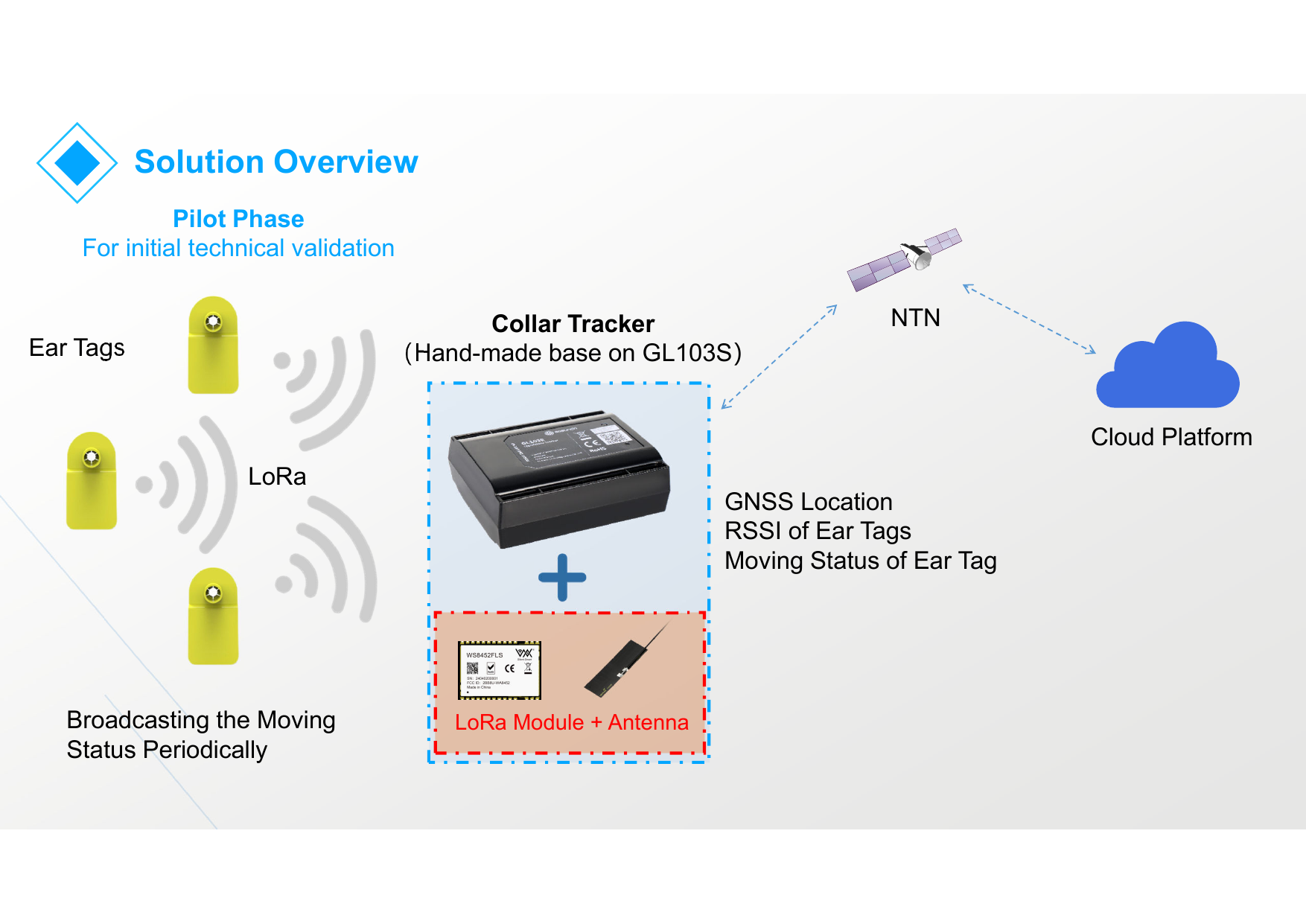
Note: We require native NB-IoT support as a core terrestrial option, not solely NTN.
Ear-Tag Strategy (Mengniu Off-The-Shelf): We accept the ~30g weight for Phase 1 (100 Tags & 5 Collars) as a compromise to accelerate validation. A custom <20g redesign is strictly required for the final rollout.
The Battery Math (Alignment Point): Gosuncn proposes a 3-year lifespan based on a 1-hour heartbeat. Our 15-minute heartbeat target would reduce this to ~9 months. We must align on battery sizing, solar capacity, or adapt telemetry frequency for Phase 1.
1. Edge Processing (GL103S MCU)
Requirement: Process telemetry locally via Zephyr/TinyML to minimize Satellite payloads.
Discussion: Does the main GL103S MCU support custom Zephyr RTOS? If it's a closed modem, what is the recommended architecture (e.g. Co-Processor) for the Pilot phase?
Requirement: Process telemetry locally via Zephyr/TinyML to minimize Satellite payloads.
Discussion: Does the main GL103S MCU support custom Zephyr RTOS? If it's a closed modem, what is the recommended architecture (e.g. Co-Processor) for the Pilot phase?
2. Local RF (WS8452FLS)
Requirement: Reliably receive data from up to 500 Ear-Tags over 1km hops.
Discussion: Can this serial AT module support the topology and high density without massive packet collisions?
Requirement: Reliably receive data from up to 500 Ear-Tags over 1km hops.
Discussion: Can this serial AT module support the topology and high density without massive packet collisions?
3. Cloud & NTN Logistics
Cloud Readiness: JAAB maintains the open-source FluxRig platform, ready to ingest data (TCP/UDP/CoAP/MQTT).
SIM Provisioning: Shipping activated NTN SIMs to China is a challenge.
Action Plan: Start debugging with standard NB-IoT SIMs while solving NTN provisioning in parallel.
Cloud Readiness: JAAB maintains the open-source FluxRig platform, ready to ingest data (TCP/UDP/CoAP/MQTT).
SIM Provisioning: Shipping activated NTN SIMs to China is a challenge.
Action Plan: Start debugging with standard NB-IoT SIMs while solving NTN provisioning in parallel.
Execution Plan & Next Steps
### Pilot Scope & Execution
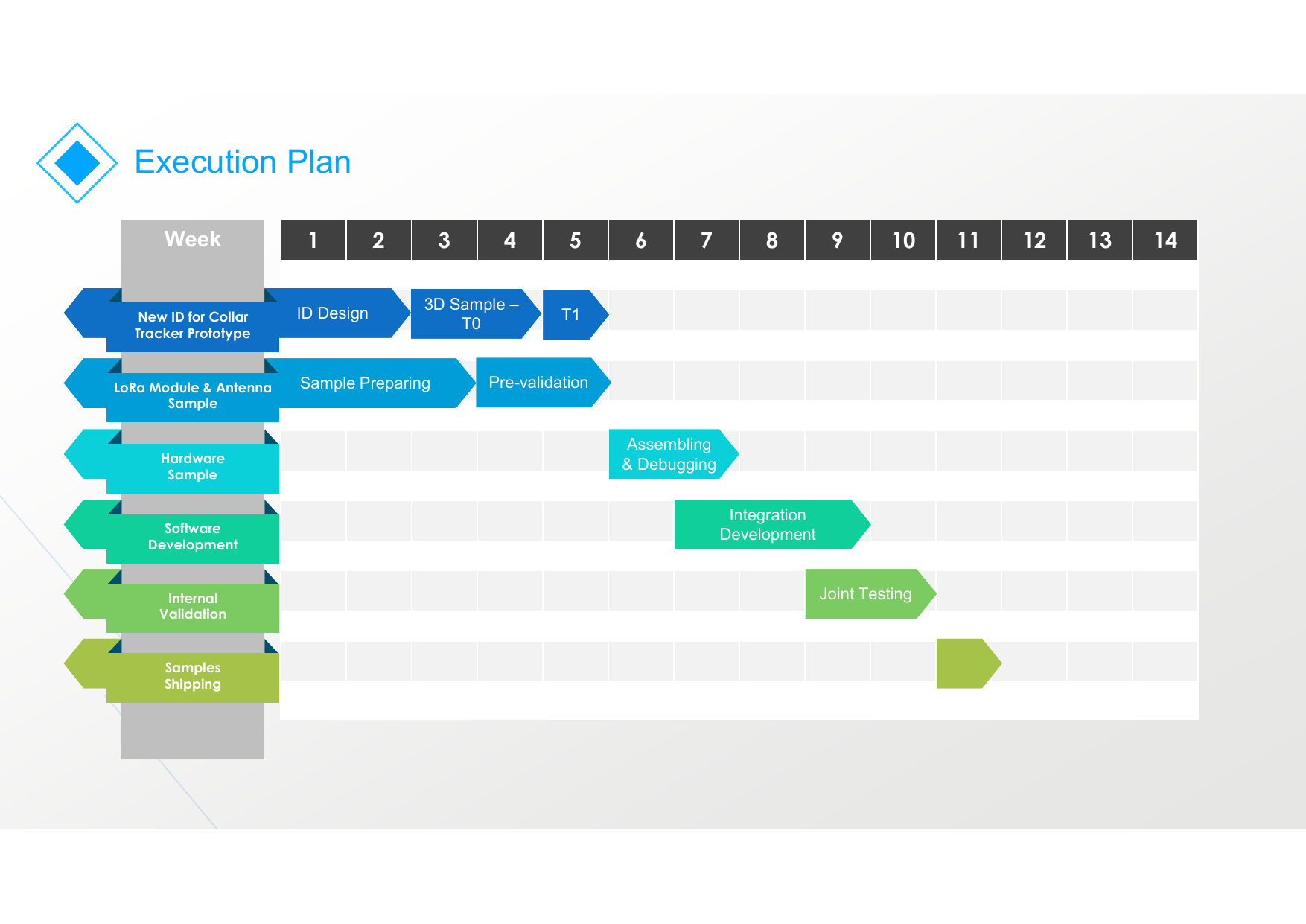 **Volume:** 100 Ear-Tags + 5 Collar Trackers + 5 Handheld Gateways
**Critical Alignment:** Define pass/fail metrics at each milestone.
**Volume:** 100 Ear-Tags + 5 Collar Trackers + 5 Handheld Gateways
**Critical Alignment:** Define pass/fail metrics at each milestone.
**Volume:** 100 Ear-Tags + 5 Collar Trackers + 5 Handheld Gateways
**Critical Alignment:** Define pass/fail metrics at each milestone.
### Strategic Discussion Points
1. **Firmware Architecture:** SDK access to GL103S for custom Zephyr/TinyML application logic.
2. **MCU & Memory:** Confirm final MCU specifications (FPU/DSP) and 16MB external SPI Flash.
3. **RF Aggregation:** Prove LoRa high node density (500 active tags) and mitigation.
4. **Device Management:** Restrict LwM2M, FOTA, and security keys provisioning to the cellular link.
5. **Local Onboarding:** Define BLE/NFC protocol for portless mobile diagnostics and activation.
6. **SIM Logistics:** Provide terrestrial NB-IoT SIMs for initial debugging in China.
7. **NRE Terms:** Milestone-based payment structure (e.g., 30% upfront, 40% T1 hardware, 30% joint testing pass).
Phase 1 Pilot Pivot (Handheld Gateway): Decouple software/RF testing from mechanical/battery challenges by using GL103S devices as handheld/vehicle-mounted backpack gateways. This allows immediate validation of the Sub-GHz cow network range and NTN satellite payload compression logic.